
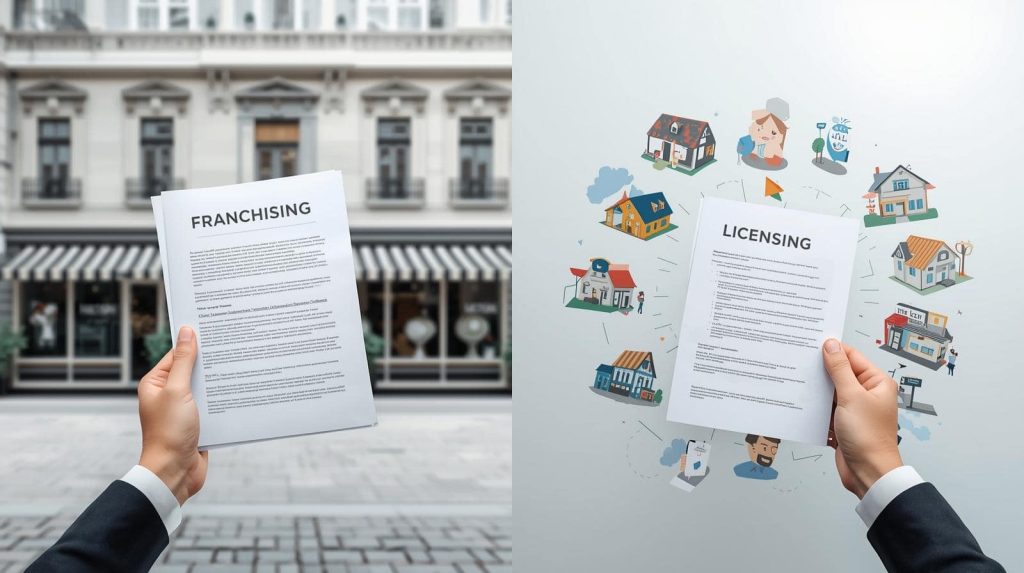
For entrepreneurs and business owners considering expansion, understanding the franchise vs license distinction is critical. While both models involve granting rights to use a brand, intellectual property, or business system, the legal and operational implications of each path are significantly different. Choosing the wrong model—or misunderstanding the legal nuances—can lead to regulatory trouble, loss of brand control, and possible business failure.
Key Legal Distinctions: Franchise vs License
At the core of the franchising vs licensing differences is the level of control exerted over the third party and the legal obligations imposed by federal and state laws. In a franchise agreement model, the franchisee typically adopts the franchisor’s entire business model, including trademarks, products, services, and methods of operation. This level of control classifies the relationship as a franchise under the Franchise Rule – FTC, enforced by the Federal Trade Commission (FTC), which triggers requirement to serve a franchise disclosure document (FDD) on franchise candidates, and compliance with franchise law. Further, a majority of state governments require compliance with statutes and regulations related to the relationship between franchisors and franchisees.
In contrast, a licensing model allows a licensee to use intellectual property—such as a trademark or technology—without the in-depth operational control which distinguishes this relationship to a franchise. This makes licensing more flexible and simpler from a regulatory standpoint. However, the legal differences between franchise and license are not just academic; misclassifying a franchise as a license can lead to severe regulatory penalties, contract nullification, and exposure to lawsuits.
Operational Control and Brand Integrity
The franchise model is ideal for companies seeking to replicate a proven system across multiple locations with consistent quality of product or services and maintaining brand integrity. Franchisors retain substantial control over how the business is run — from signage and uniforms to pricing structures and customer service. Franchisees take the part of franchise business owners, as well as employers.
On the other hand, licensors typically have limited say in how licensees operate their business. While this allows greater freedom for licensees, it can result in inconsistencies that weaken brand perception. For businesses where brand control is less critical, or where customization is key, a licensing strategy may be the better route.
Regulatory Compliance and Risk
One of the most important legal differences between the franchise and license options is regulatory compliance. Franchising is heavily regulated. Franchisors must comply with extensive disclosure and registration rules that vary by state. Check state-specific franchise laws.
Licensing, while generally less regulated, still carries risks—particularly around intellectual property misuse or breach of contract. It’s crucial that any licensing agreement clearly defines scope, limitations, and enforcement mechanisms. Be cautious about whether the license model being offered is truly a licensee-licensor relationship, as sometime, whether intentional or not, the licensor may in fact be offering a franchise. One red flag to look for is an up-front licensing fee, but then periodic fees thereafter (in an other word, royalties).
Pros and Cons of Franchising vs Licensing
Evaluating the pros and cons of franchising vs licensing helps business owners align their expansion strategy with their long-term goals:
Pros of Franchising:
- Greater brand control;
- Uniform customer experience;
- Franchisor support;
- Shared marketing and operational systems; and
- Ongoing revenue through royalties.
Cons of Franchising:
- Higher legal compliance burden (annual registration required in certain states);
- Greater franchise management involvement; and
- Initial setup costs (legal documents, registrations, build-out, etc.).
Pros of Licensing:
- Easier to set up;
- Lower legal and administrative burden; and
- Flexibility for both parties.
Cons of Licensing:
- Limited brand control;
- Risk of misuse or brand inconsistency; and
- Potential for weakened brand recognition.
Making the Right Choice
The decision between franchising and licensing should not be taken lightly. Entrepreneurs must assess their business model, desired level of involvement, risk tolerance, and long-term vision. Engaging experienced legal counsel is essential to drafting – or reviewing – the appropriate agreements, maintaining compliance, and avoiding unintended legal consequences.
At Kilcommons Law, we offer comprehensive guidance to help you navigate the franchise vs license decision. Whether you’re leaning toward a franchise business model or considering a licensing business strategy, our team can help ensure your expansion plans are built on a strong legal foundation.
Need help evaluating your business expansion options? Contact Kilcommons Law today to schedule a consultation and get the experienced legal support you need.
© Kilcommons Law, P.C. 2025
